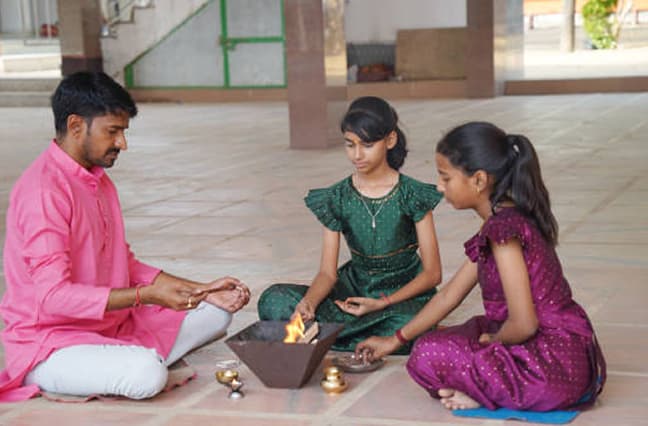
Vastu Shanti Pooja is a more elaborate and time consuming Hindu ritual, and often spans between 2 and 4 hours depending on the family tradition, the local custom and the magnitude of the puja that is being conducted. The following is an actual, step-by-step description of the way the ceremony takes place:
Kalash Sthapana and Sankalp (Sacred Resolve): The ritual starts by having the main Kalash, a copper/brass pot of water, a coconut, mango leaves and sacred grains, placed by the priest. The Kalash is the symbol of the universe and the existence of all the divine. Once the first installation is completed and a small purification of the prayer space with the use of Ganga Jal is made, the family members along with the priest sit down and say Sankalp a declaration of intent wherein the priest recites the family name, gotra (lineage), location and the reason as to why the pooja is being carried out. The Sankalp is a spiritual commitment which binds, and it provides the energy and concentration of the whole ceremony.
Ganesh Puja and Navgraha Puja: As with practically all Hindu ceremonies Vastu Shanti is initiated with the invocation of Lord Ganesha, the destroyer of impediments. The priest recites the Ganesh Atharvashirsha or Ganesh Panchanga, does a little but full puja to the Ganesh god or picture, and takes his blessings to have a successful ceremony without any obstruction. Then the Navagraha Puja is conducted - nine little pots or drawn images of the Sun, Moon, Mars, Mercury, Jupiter, Venus, Saturn, Rahu, and Ketu are adored using their respective grains, flowers, colours and mantras. This is essential since the Navagrahas control cosmic forces that have direct influence on the health, wealth, relationship and general fate of the residents.
Vastu Purush Puja (The Heart of the Ceremony): It is the most critical and the main ritual of Vastu Shanti Pooja. The priest paints the Vastu Mandala or the Vastu Purusha Mandala which is a divine geometrical pattern on a plank of wood, copper plate or on the ground using a rice flour. This is a 9x9 or 8x8 grid that is an embodiment of the body of the Vastu Purush and the 45 divine agents dominating various areas of the home. The Vastu Purush is then given a comprehensive puja by the priest as he chants Vastu Suktas of Atharva Veda: shannodevi-rabhishtaya aapo bhavantu pitaye, shan yorabhisravantu nah... and certain Vastu mantras such as "Om Vastu Purushaya Namaha" are repeated. Flower, rice, turmeric and sindoor and sweets offerings are given at various parts of the mandala. Emphasis is put on the northeast corner of the mandala, the Ishanya zone which is under the jurisdiction of divine forces.
Pancha Bhoota Aradhana (Worship of Five Elements): during this part of the pooja, the priest undertakes certain rituals in honouring and balancing the five elements in the home. At the north east corner water is celebrated with a Kalash of sacred water and flowers. At the south east corner, fire is celebrated using lamps and agarbatti. At the southwestern corner, there is a pot of sacred soil with which Earth is revered. Air is revered to the northwest corner by incense and waving of a fan. Space is also revered in the middle of the house using a lamp and flowers. This Pancha Bhoota Aradhana is an attractive ceremony which recognizes the natural world as divine and asks its mercy to the prosperity of the household.
Griha Devata Puja (Lord of the house): Hindus have numerous traditions of a special deity the protector of home Lakshmi, Durga, Vishnu or Shiva, the god of the family among others, based on the Kula Devata (family god) of the family. Here the Kula Devata of the family and the Griha Devata in general is addressed and offered prayers through flowers, incense, lamps and food offerings.
Havan (Sacred Fire Ritual): Most spiritually powerful in the ceremony is the Havan. A wooden Havan Kund is prepared, a traditional Havan Kund is generally in the northeast or the centre of the house and a sacred fire is lit with mango wood, camphor, and peepal twigs. Afterward, the priest recites certain Vastu Homa mantras with every offering of ghee, sesame seeds, barley, and the special Havan Samagri (mixture of medicinal herbs, such as guggul, shatavari, ashwagandha, sandalwood powder, and dried cow dung) to the fire. Vastu mantras that are recited at the Havan are Vastu Sukta (to protect health), Maha Mrityunjaya Mantra (to protect health), Sri Sukta (to bring good fortune and the blessings of Lakshmi), and certain Shanti Patha chanting of the Yajur Veda. It is said to physically and spiritually clean up the whole area by the smoke and heat of the Havan.
Pradakshina (Circumambulation of the Home): the family is following the lead of the priest who performs a ceremony of walking awwards around the house with recitation of mantras and sprinkling of sacred water, Ganga Jal and in certain cases turmeric water in each corner of the house after the main rituals. This ritual is referred to as Griha Pradakshina and is a means of ensuring that all areas of the house such as storerooms, bath rooms, and dark areas all receive the healing power of the ritual.
Shanti Patha and Purnahuti: The ritual is finalised by the Shanti Patha - a great peace formula that is chanted three times in the form of an invocation: "Om Dyauh Shantirantariksha Shanti, Prithvi Shantiraapah Shantir.... praying to have peace in all aspects of life. The last offering to the Havan fire is the Purnahuti that is a massive offering that has a coconut, fruits, ghee, and all the remaining Havan samagri and this marks the successful end of the yagna. The priest then blesses each of the members of the family by tying a holy thread in their wrists and applying kumkum and chandan on their foreheads.